Flat iron – flat bar and steel strip – is one of the most common starting shapes in metal fabrication, but it rarely stays flat. It becomes handrails, brackets, frames, rings, decorative scrolls, and structural components. A flat iron forming machine is the equipment that bends, curves, rolls, or profiles that flat section into a finished shape. Unlike a dedicated single-purpose former, this category covers several machine types, each suited to different shapes and volumes. This article reviews the main types, what they do, the parameters that matter, where they are used, and how to choose.
What Is a Flat Iron Forming Machine?
The term describes a group of machines that plastically deform flat iron into a desired geometry. The common thread is that force is applied to take the material past its yield point so it holds a new shape after the force is removed. The machines differ in how that force is applied: rollers for gradual curving, dies in a press for discrete bends, or a rotating arm for scrolls and ornaments. Picking the right type starts with the shape you need to make.
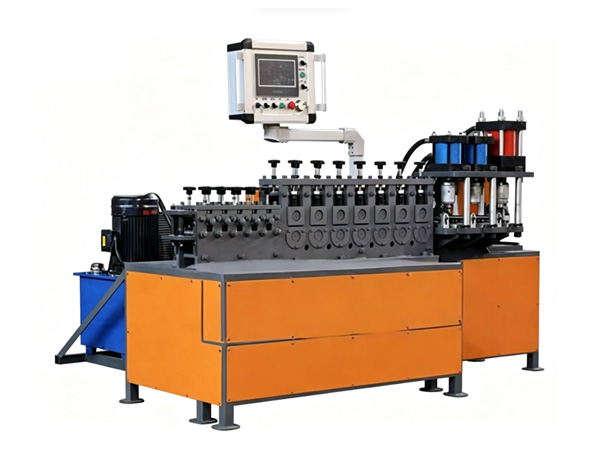
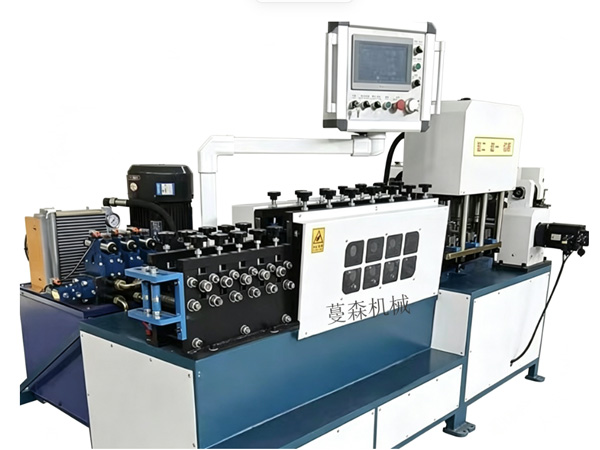
How Does Flat Iron Forming Work?
Forming relies on bending the section beyond its elastic limit. In roll forming or section bending, the flat bar passes through rollers set to progressively curve it; the final radius is fixed by roller position. In press bending, a punch forces the bar into a die to make a specific angle or bend. In scroll or ornamental bending, a rotating former shapes the bar into decorative curves. Material thickness, width, and grade set how much force and what tooling are required, and they also determine springback – the slight return toward flat after forming.
Common Forming Methods
Roll bending – three-roll or four-roll machines curve flat bar into arcs and rings.
Press bending – die-based bending for angles, brackets, and custom profiles.
Scroll / ornamental bending – rotating tooling for decorative shapes.
Hoop and ring forming – continuous curling of strip into hoops (covered in depth separately as a hoop forming machine).
Main Types of Flat Iron Forming Machines
Flat Bar Bending Machine (Section Bender)
A section bender uses rollers to bend flat bar into rings, arcs, and spirals. It is the workhorse for producing rings and curved frames from flat iron and is available in manual, hydraulic, and CNC versions depending on accuracy and volume needs.
Flat Iron Hoop and Ring Forming Machine
For continuous production of circular hoops from strip, a dedicated hoop forming line decoils, curves, cuts, and joins the ring automatically. This is a specialized subset of flat iron forming focused on repeatable circles; the broader category described here also covers non-circular work.
Press Brake for Flat Iron
A press brake with the right tooling bends flat bar into angles, brackets, and custom profiles. It excels at discrete, repeatable bends rather than continuous curves, and is common where parts need precise angles.
Scroll and Ornamental Bending Machine
Used for decorative metalwork, this machine forms flat iron into scrolls, volutes, and railings. It favors shape flexibility over high volume and is typical in furniture, balustrade, and architectural metalwork shops.
Profile and Roll Forming Machine
For long runs, a roll forming line progressively shapes flat strip into a consistent cross-section. Although often associated with thin strip, the same principle applies to flat iron profiling where a constant section is needed at length.
Functions of Flat Iron Forming Machines
Bending to a radius – arcs and curved members for frames and rails.
Ring and hoop making – circular parts from flat strip.
Angle bending – brackets, clips, and structural connections.
Ornamental scrolling – decorative curves for railings and furniture.
Profiling – constant cross-sections produced at length.
Combined operations – some lines cut, pierce, or punch as part of forming.
Key Technical Parameters
Section size – maximum flat bar width and thickness the machine handles.
Bending radius range – minimum and maximum radius, including the tightest bend the tooling allows.
Capacity (section modulus) – a measure of the bending resistance the machine can overcome.
Drive type – manual, hydraulic, or CNC, affecting force, repeatability, and labor.
Speed – cycles or length per minute for continuous processes.
Tooling – rollers, dies, and formers required for each shape; changeover time matters for mixed work.
Material compatibility – mild steel, stainless, and aluminum each behave differently.
Power and footprint – site services and floor space.
Exact specifications vary widely by machine type and model, so confirm the datasheet for the specific equipment and the exact section you intend to form.
Materials and Springback
Mild steel flat bar is the default material. Stainless steel is stronger and springs back more, requiring greater force and sometimes over-bending to hold the target radius. Aluminum springs back as well and needs careful tooling to avoid surface marks. Because springback varies with material and thickness, setup often includes a small over-form that is verified against a sample before a production run.
Industrial Uses of Flat Iron Forming
Handrails, balustrades, and architectural metalwork
Structural frames, brackets, and supports
Machinery guards and equipment bases
Furniture, shelving, and display structures
Decorative and ornamental ironwork
Construction reinforcement and formwork
HVAC and ductwork flanges
Agricultural and trailer frames
The breadth of uses is why "flat iron forming" spans several machine types: the right equipment depends on whether the part is a ring, an angle, a scroll, or a long profiled section.
How to Choose the Right Machine
Start from the shape – rings need a section bender or hoop line; angles need a press brake; scrolls need an ornamental bender; constant sections need roll forming.
Match section size and radius – confirm width, thickness, and the tightest radius against the machine's capacity.
Account for material – stainless and aluminum need more force and careful tooling.
Set the volume – manual for low volume, hydraulic or CNC for repeat, high-accuracy work.
Weigh accuracy and repeatability – CNC control reduces setup scrap on long runs.
Plan tooling changeover – mixed shapes mean more changeover; factor it into scheduling.
Verify safety and support – guarding, control safety, machinery risk assessment (for example ISO 12100), spare parts, and service.
Maintenance and Operating Considerations
Rollers and bearings – clean, lubricate, and inspect for wear that changes radius.
Hydraulic system – if fitted, check oil, seals, and pressure per schedule.
Dies and tooling – inspect for cracking or wear that degrades bend quality.
Alignment and calibration – verify roller and die positions so parts stay in tolerance.
Operator setup – sample-check the first part to confirm radius and springback compensation.
What to Provide When Requesting a Quote
Flat bar width, thickness, and grade (including stainless or aluminum if used)
Shapes required (rings, angles, scrolls, profiles) and target radii
Tolerances and production volume
Preferred drive (manual, hydraulic, CNC)
Power supply (voltage, phase, frequency)
Required certifications and shipping or container requirements
Any combined operations such as cutting or piercing
Manufacturers such as Botou Mansen Machinery publish their manufacturing capabilities so buyers can verify process control before ordering. You can review the company profile at the manufacturer's about page, and explore related fabrication equipment at.
FAQ
What is the difference between flat iron forming and hoop forming?
Hoop forming is a specialized type of flat iron forming focused on continuous circular hoops from strip. Flat iron forming is the broader category covering rings, angles, scrolls, and profiles from flat bar. If you only make hoops at volume, a dedicated hoop line is more efficient; for varied shapes, a section bender or press brake is more flexible.
Can these machines form stainless steel and aluminum?
Yes, but both spring back more than mild steel and need greater forming force and careful tooling. Stainless also work-hardens, so setup may require over-bending and verification against a sample.
What is the minimum bending radius for flat iron?
It depends on the bar width, thickness, material, and machine tooling. Wider or thicker sections need larger minimum radii. The specific minimum should come from the machine and tooling specification for your exact section.
Should I choose a manual or CNC flat iron forming machine?
Manual machines suit low volume and custom one-off work. CNC machines suit repeat production where accuracy, repeatability, and reduced setup scrap justify the higher cost.
How does springback affect flat iron forming?
After force is removed, the material slightly returns toward flat. Setup compensates by over-forming by a calculated amount, then verifying the finished radius on a sample before the run.
Conclusion
A flat iron forming machine is not one machine but a family – section benders, press brakes, scroll benders, hoop lines, and roll formers – each matched to a shape and volume. The underlying principle is the same: apply force past yield to set a permanent bend, with radius and springback controlled by tooling and setup. The buying decision should start from the part shape, then match section size, radius, material, and production volume, rather than from a generic "forming machine" label.
Before requesting a quote, list the shapes and radii you must produce, the flat bar dimensions and grades, the required tolerances, and the expected volume. Confirm the machine covers your section and radius with available tooling, and review the supplier's manufacturing capability and after-sales support, since tooling changeover and spare parts often decide total cost of ownership more than the base machine price.
References
ISO 12100:2010, Safety of machinery – General principles for design – Risk assessment and risk reduction. International Organization for Standardization.
ASTM A1011/A1011M, Standard Specification for Steel, Sheet and Strip, Hot-Rolled, Carbon, Structural, High-Strength Low-Alloy, and High-Strength Low-Alloy with Improved Formability. ASTM International.
Kalpakjian, S., & Schmid, S. R. (2014). Manufacturing Engineering and Technology (7th ed.). Pearson.
Hosford, W. F., & Caddell, R. M. (2011). Metal Forming: Mechanics and Metallurgy (4th ed.). Cambridge University Press.