Flat bar is one of the most versatile starting shapes in metal fabrication. It becomes handrails, brackets, frames, clips, rings, and structural members. A flat bar forming machine bends, curves, or shapes that flat section into a finished part. The term covers several machine types, each suited to different part geometries and production volumes. This guide explains the main configurations, where they are used, and how to choose one.
What Is a Flat Bar Forming Machine?
A flat bar forming machine plastically deforms flat bar or flat strip past its yield point so it holds a permanent shape after the forming force is removed. The machine type determines whether the output is a tight radius bend, a continuous ring, a structural angle, or a decorative scroll. The common requirement is that the machine must deliver enough force and control for the material grade, thickness, and width being processed.
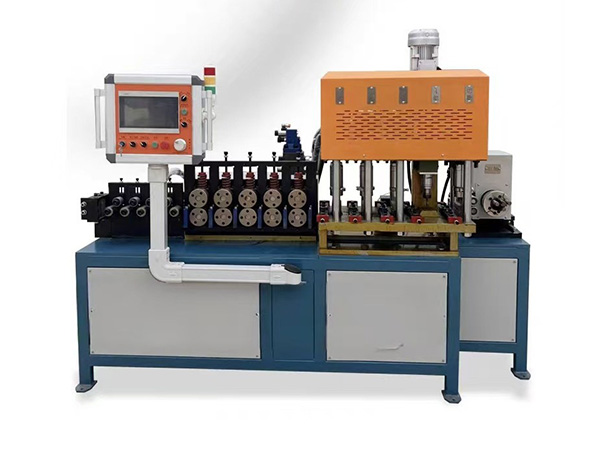
Main Types
Section Bender (Roll Bender) for Flat Bar
A three-roll or four-roll bender feeds flat bar through rotating rollers set to progressively curve it into an arc or full ring. This is the standard machine for forming rings, circular frames, and curved members. It is available in manual, hydraulic, and CNC-driven versions, with CNC models offering programmable radius control and springback compensation.
Press Brake for Flat Bar
A press brake with a matched upper punch and lower die bends flat bar to a specific angle. It excels at discrete, repeatable bends such as brackets, clevises, and structural angles. CNC press brakes with servo-controlled back gauges deliver tight dimensional accuracy across long production runs.
Flat Iron Bending Machine (Manual or Hydraulic)
A dedicated flat bar bender uses a rotating mandrel or bending arm to form flat stock around a radius. These machines range from bench-top manual tools for light fabrication to hydraulic floor-standing units for structural bar. They are suited to lower-volume work and custom bending where a full press brake or roller line is not justified.
CNC Flat Bar Forming and Profile Bending Machine
CNC-controlled benders with multiple forming stations can produce complex 2D or 3D shapes from flat bar in one setup. These are typically used for specialized fabrication such as sign clamps, solar brackets, and architectural metalwork where part repeatability and dimensional accuracy are critical.
Hoop and Ring Forming Line
For continuous high-volume production of circular hoops from flat strip, a dedicated hoop forming line decoils, curves, cuts, and joins rings automatically. This is a specialized subset focused on one shape at high throughput.
Applications
The breadth of flat bar as a starting shape means these machines appear across many industries:
Handrails, balustrades, and architectural metalwork
Structural brackets, clips, and connection plates
Solar mounting brackets and sign clamps
Machinery guards, frames, and equipment bases
Furniture, shelving, and display structures
Trailer frames, agricultural equipment, and vehicle components
HVAC ductwork flanges and mounting hardware
Decorative ironwork and ornamental railings
Cable reel rings and barrel hoops
Construction reinforcement and formwork rings
Key Technical Parameters
Bar size range – maximum width and thickness the machine accepts.
Bending radius range – minimum and maximum radius achievable, including tightest bend with available tooling.
Force or capacity – nominal force or section modulus, indicating the bending resistance the machine can overcome.
Drive type – manual, hydraulic, or CNC, affecting force, accuracy, and operator labor.
Springback compensation – whether the machine accounts for material springback automatically, important for stainless and aluminum.
Tooling range – the radii and profiles available on standard or optional tooling.
Accuracy and repeatability – dimensional tolerance and batch consistency, especially relevant for CNC machines.
Power and footprint – site power requirements and floor space.
As a category reference, flat bar benders commonly handle widths from 10 mm up to 100 mm or more, and thicknesses from 1 mm to 12 mm or more, depending on the machine class. Exact specifications must come from the datasheet for the specific model.
Materials and Forming Considerations
Mild steel is the most common material and bends readily. Stainless steel has higher strength and greater springback, requiring more force and careful over-bending to hold the target radius. Aluminum springs back more than mild steel and is more prone to surface marking, so tooling and pad material matter.
Springback is the key phenomenon. After the forming force is removed, the material returns slightly toward its original flat shape. The amount depends on material grade, thickness, width, and the target radius. Setup typically involves forming a sample, measuring the result, and adjusting the target to compensate. CNC machines with springback compensation use stored data to reduce this trial-and-error step.
How to Choose the Right Machine
Start from the part shape. Rings and arcs point to a section bender. Angles and brackets point to a press brake. Custom decorative shapes point to a scroll bender or CNC former. Hoops at volume point to a hoop forming line.
Match section size. Confirm the machine's maximum width and thickness cover your flat bar range with margin.
Set the radius range. Check that the machine's minimum achievable radius is tight enough for your sharpest bend.
Account for material. Stainless and aluminum need more force and springback compensation. If you run these materials regularly, size the machine for them, not just for mild steel.
Weigh production volume. Manual machines suit low-volume custom work. Hydraulic or CNC machines suit repeat production where labor and accuracy matter.
Evaluate accuracy requirements. CNC control with servo back gauges and springback compensation delivers tighter tolerances than mechanical indexing.
Plan tooling. Check what tooling is standard, what is optional, and the lead time and cost for custom radii or profiles.
Verify safety and support. Check guarding, control safety (for example ISO 12100 for machinery risk assessment), spare parts availability, and service support.
Maintenance and Operating Considerations
Rollers and bearings. Clean and lubricate forming rollers and support bearings. Check for wear that changes the achieved radius.
Hydraulic system. If the machine has hydraulic drives, check oil level, seals, and pressure on schedule.
Dies and tooling. Inspect bending dies for cracking, wear, or surface damage that degrades part quality.
Alignment and calibration. Verify roller positions and back gauge zero points periodically to maintain dimensional accuracy.
Operator sampling. Check the first part of each batch or shift against a reference to catch setup drift before producing scrap.
What to Provide When Requesting a Quote
Flat bar width, thickness, and grade (including stainless or aluminum if used)
Shapes required and target radii or angles
Required tolerances and production volume
Preferred drive type (manual, hydraulic, CNC)
Power supply (voltage, phase, frequency) at the installation site
Required certifications and shipping or container requirements
Any custom tooling, patterns, or combined operations such as cutting or notching
Manufacturers such as Botou Mansen Machinery publish their manufacturing capabilities so buyers can verify process control and production scale before ordering. You can review the company profile at the manufacturer's about page, and explore related fabrication equipment at he main product site.
FAQ
What is the difference between a flat bar forming machine and a press brake?
A press brake is one type of flat bar forming machine, suited to discrete angle bends with die tooling. Other types include section benders for rings and arcs, scroll benders for decorative shapes, and CNC formers for complex 2D/3D parts. The right choice depends on the part shape.
Can a flat bar forming machine handle stainless steel and aluminum?
Yes, but both materials spring back more than mild steel and require more forming force. Stainless also work-hardens, which can limit the minimum achievable radius without cracking. Size the machine for the hardest material in your regular workload.
What is the minimum bending radius for flat bar?
It depends on the bar width, thickness, material, and machine tooling. As a rough guide, the minimum radius is typically one to three times the bar thickness for mild steel, and larger for stainless and aluminum. The specific figure should come from the machine and tooling specification for your exact section.
How does springback affect flat bar forming?
After the forming force is removed, the material elastically returns toward flat. The amount of springback depends on material, thickness, width, and the target radius. Setup involves forming a sample, measuring it, and adjusting the target bend angle to compensate. CNC machines with springback compensation reduce this trial step.
Should I choose manual, hydraulic, or CNC control?
Manual machines suit low-volume custom or maintenance work. Hydraulic machines suit moderate-volume repeat bending where more force is needed. CNC machines suit high-volume production where accuracy, repeatability, and springback compensation justify the higher cost.
Conclusion
A flat bar forming machine is not one machine but a family – section benders, press brakes, scroll benders, CNC formers, and hoop lines – each suited to different part geometries and volumes. The buying decision should start from the part shape, then match section size, material, production volume, and accuracy requirement. For B2B buyers, the practical value is consistent part geometry, lower labor cost, and the ability to produce at the tolerances downstream assembly demands.
Before requesting a quote, document the flat bar dimensions and grades, the shapes and radii or angles required, the tolerances, and the expected volume. Confirm the machine covers your section and radius with available tooling, and review the supplier's manufacturing capability and after-sales support, since tooling availability and service affect long-term cost more than the headline machine price.
References
ISO 12100:2010, Safety of machinery – General principles for design – Risk assessment and risk reduction. International Organization for Standardization.
ASTM A1011/A1011M, Standard Specification for Steel, Sheet and Strip, Hot-Rolled, Carbon, Structural, High-Strength Low-Alloy. ASTM International.
Hosford, W. F., & Caddell, R. M. (2011). Metal Forming: Mechanics and Metallurgy (4th ed.). Cambridge University Press.
Kalpakjian, S., & Schmid, S. R. (2014). Manufacturing Engineering and Technology (7th ed.). Pearson.