Many metal products depend on a simple circular part: the hoop. Barrel and drum hoops, cable reel rings, tire bead rings, and construction reinforcement rings all start as straight flat iron or steel strip that must be curved into a precise circle and joined. A flat iron hoop forming machine performs this continuously, feeding strip through a forming section that curls it into a hoop, cutting it to length, and in many lines joining the ends. This article explains how the machine works, the configurations available, the parameters that matter, where hoops are used, and what to check before buying.
What Is a Flat Iron Hoop Forming Machine?
A flat iron hoop forming machine is a production line that converts flat strip or flat bar into circular hoops or rings. The process is typically continuous: a coil of strip is paid off, levelled, fed at a controlled rate, curved progressively by forming rollers, cut to the required length, and the ends are joined to make either an open or a closed ring. The same principle applies whether the output is a tight barrel hoop or a large cable reel ring; only the tooling and diameter settings change.
The main advantage over manual bending is consistency. Hand-formed rings vary in diameter and joint fit, which causes assembly problems downstream. A formed line holds diameter and length within a tight band, which matters when hoops must stack, weld, or fit a barrel or drum body.
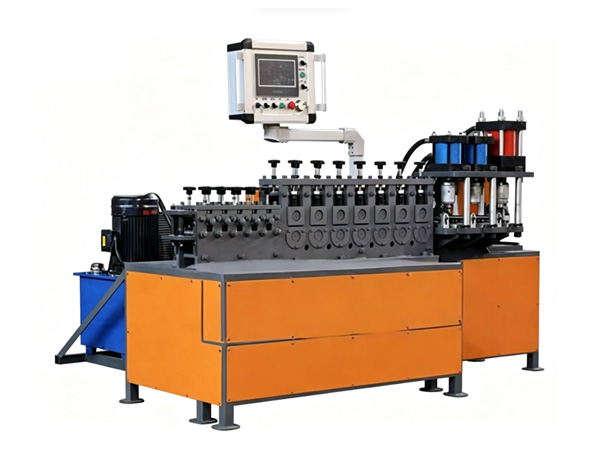
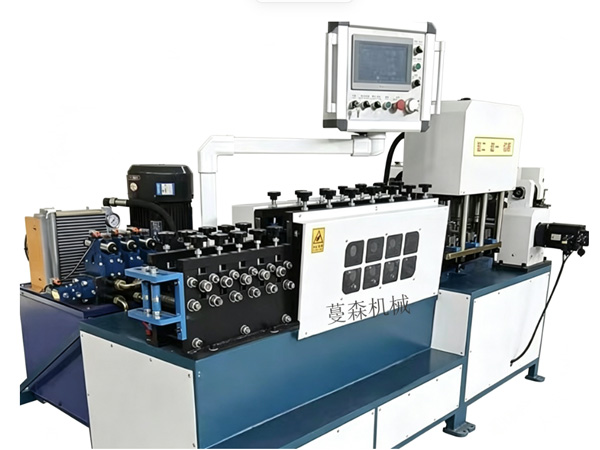
How Does It Work?
The working principle is a staged deformation of the strip rather than a single bend.
Decoiling and levelling – a coil payoff feeds strip into a leveller that removes coil memory so the material enters the former flat.
Controlled feeding – a servo or mechanical feeder advances a set length per cycle, which sets the final hoop circumference.
Progressive forming – profiled rollers bend the strip edges and curve the section until it becomes a full or near-full circle. Curvature is set by roller position and gap.
Cutting to length – a flying shear or punch cuts the hoop from the continuous strip at the exact length needed for the target diameter.
Jointing – the ends are joined by overlap crimping, locking, or welding to produce a closed ring, or left open for later assembly.
Diameter is determined by the forming tooling and the feed length. Because the deformation is gradual, the strip does not crack at the edges if the tooling and reduction per stage are set correctly for the material thickness.
Key Components
Decoiler / payoff stand – holds and feeds the strip coil with adjustable tension.
Leveller – flattens the strip before forming.
Feeder – servo or mechanical, controls length accuracy.
Forming station – profiled rollers that curve the strip into a hoop.
Cutting unit – flying shear or punch for cut-to-length.
Jointing unit – welder, crimper, or locker for the ring joint.
Control system – PLC with length and speed setting, often with a touchscreen.
Discharge and stacking – collects finished hoops for packing.
Main Types of Flat Iron Hoop Forming Machines
Manual or Single-Station Hoop Bender
An operator feeds and forms hoops one at a time, often with a hand-cranked or foot-operated former. These suit low volume, maintenance, or custom rings where a full line is not justified. Output depends on operator skill and is less consistent than automated forming.
Automatic Flat Iron Hoop Forming Machine
A continuous, PLC-controlled line handles decoiling, levelling, feeding, forming, and cutting automatically. This is the standard choice for barrel hoops, drum rings, and other high-run parts where diameter and length repeatability drive downstream assembly.
Hoop Forming with Integrated Welding
For closed rings, the line includes a welding station that joins the ends as part of the cycle. This removes a separate manual welding step and gives a consistent joint, important for load-bearing or pressure-containing rings.
Combined Cutting and Forming Lines
Some machines cut strip to length and form the hoop in one sequence, suited to straps, bands, and rings where the material arrives in shorter lengths rather than coils.
Key Technical Parameters
Strip width and thickness – the flat iron dimensions the machine accepts; these set the cross-section of the finished hoop.
Hoop or ring diameter range – the minimum and maximum diameters the tooling can produce.
Forming speed / output – pieces per minute or per hour, which must match your production requirement.
Material compatibility – mild steel, galvanized steel, or stainless, each with different tooling and force needs.
Cutting method – shear or punch, affecting edge quality and tooling wear.
Joint type – open, crimped, locked, or welded, depending on the application.
Length accuracy – set by the feeder and control; tighter tolerance means better diameter control.
Motor power and drive – indicate capacity and energy use.
Decoiler capacity – maximum coil weight and width the payoff handles.
Exact figures vary by model, so always confirm the datasheet for the specific machine. Treat the strip thickness and diameter range as the first screening criteria, since they define what the line can physically produce.
Materials and Tooling Considerations
Mild steel strip is the most common raw material for hoops. Galvanized strip is used where corrosion resistance matters, such as outdoor drums and cable reels, but the coating affects tooling wear and joint quality. Stainless strip is specified for food, pharmaceutical, or corrosive environments and needs more forming force and careful joint preparation.
Edge condition matters. Strip with heavy burr or rolled edges can produce hoops with poor joint fit or surface snags. Tooling is diameter-specific: rollers and guides are sized to the target hoop, so changeover between diameters takes time and should be factored into scheduling for mixed production.
Industrial Applications
Barrel and drum hoops for packaging and storage
Cable reels and spools for wire and cable
Tire bead rings and wheel hoops
Construction reinforcement rings and formwork rings
Strapping and packaging bands (related flat strip products)
Furniture and decorative rings
Agricultural equipment rings and frames
In every case the hoop must hold a consistent diameter and joint so it assembles, welds, or stacks without rework.
How to Choose the Right Machine
Define diameter range – list the hoop diameters you must produce and check the machine covers them with available tooling.
Match strip dimensions – confirm width and thickness range against your material.
Set the production volume – choose manual for low volume, automatic for continuous runs.
Decide the joint – open, locked, or welded; welded lines cost more but remove a manual step.
Consider material – galvanized or stainless needs appropriate tooling and joint preparation.
Check length and diameter accuracy – PLC control with servo feeding gives the tightest repeatability.
Review line integration – decoiler capacity, discharge, and packing affect real throughput.
Verify safety and support – guarding, control safety (relevant standards such as ISO 12100 for machinery risk assessment), spare parts, and service.
Maintenance and Operating Considerations
Rollers and guides – clean and lubricate; check for wear that changes diameter.
Bearings and drives – inspect for play and unusual noise.
Cutting blades – sharpen or replace on schedule to keep clean edges.
Welding unit – if fitted, maintain tips, gas, and alignment per the welder's guidance.
Feeder and sensors – calibrate length feedback so diameter stays in tolerance.
Decoiler brake and tension – keep strip tension stable to avoid feed errors.
What to Provide When Requesting a Quote
Strip width, thickness, and grade (including galvanized or stainless if used)
Required hoop diameters and tolerances
Joint type (open, locked, or welded)
Production rate and shift pattern
Coil size and weight for decoiler sizing
Power supply (voltage, phase, frequency)
Certifications, packing, and shipping or container requirements
Any custom tooling or automation needs
Manufacturers such as Botou Mansen Machinery publish their production capabilities so buyers can verify process control before ordering. You can review the company profile at the manufacturer's about page, and explore related fabrication equipment at the main product site.
FAQ
What is the difference between a flat iron hoop forming machine and a flat iron bender?
A bender typically forms one ring at a time and may be manual, while a hoop forming machine is a continuous line that decoils, forms, cuts, and often joins hoops at volume. The bender suits occasional or custom work; the forming line suits repeat production.
Can one machine make different hoop diameters?
Yes, within the machine's diameter range, but each diameter usually needs its own forming rollers and guide settings. Changing diameters is a tooling changeover, so plan production in diameter batches to reduce downtime.
What materials can be formed into hoops?
Mild steel is standard. Galvanized and stainless strip can also be formed, but they demand different tooling wear allowances and, for stainless, more forming force and careful joint preparation.
Should the joint be welded or locked?
It depends on the application. Welded closed rings suit load-bearing or sealed parts but add equipment and process control. Locked or crimped joints are simpler and adequate for many strapping and reinforcement hoops.
How fast can a flat iron hoop forming machine run?
Output depends on strip thickness, diameter, and whether cutting and joining are integrated. Automatic lines run far faster than manual formers; the specific rate should come from the model's datasheet for your exact strip and hoop size.
Conclusion
A flat iron hoop forming machine solves a specific production problem: turning straight flat strip into consistent circular hoops and rings without manual bending. The principle is staged roller forming with controlled feed length and cut-to-length jointing, but the buying decision depends on diameter range, strip dimensions, production volume, and joint type. For B2B buyers, the practical value is repeatable diameter and length, lower labor per hoop, and smoother downstream assembly.
Before requesting a quote, document your strip grade and dimensions, the hoop diameters and tolerances, the joint type, and the required output. Confirm the machine covers those with available tooling, and review the supplier's manufacturing capability and after-sales support, since tooling changeover and spare parts affect long-term cost more than the headline speed.
References
ISO 12100:2010, Safety of machinery – General principles for design – Risk assessment and risk reduction. International Organization for Standardization.
ASTM A1011/A1011M, Standard Specification for Steel, Sheet and Strip, Hot-Rolled, Carbon, Structural, High-Strength Low-Alloy, and High-Strength Low-Alloy with Improved Formability. ASTM International.
Kalpakjian, S., & Schmid, S. R. (2014). Manufacturing Engineering and Technology (7th ed.). Pearson.
Hosford, W. F., & Caddell, R. M. (2011). Metal Forming: Mechanics and Metallurgy (4th ed.). Cambridge University Press.