Perforated gypsum board is a standard material in acoustic ceilings and wall panels across commercial buildings, schools, hospitals, and public spaces. The holes that make those panels sound-absorbing are not drilled individually by hand. They are punched in controlled patterns by a gypsum board punching machine, a production-line tool that delivers consistent hole geometry, spacing, and open area at volume. This article walks through the key features of these machines, where they are used, and what a buyer should evaluate before purchasing.
What Is a Gypsum Board Punching Machine?
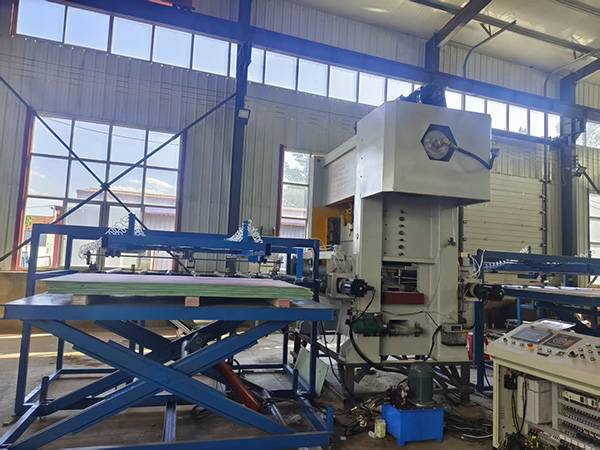
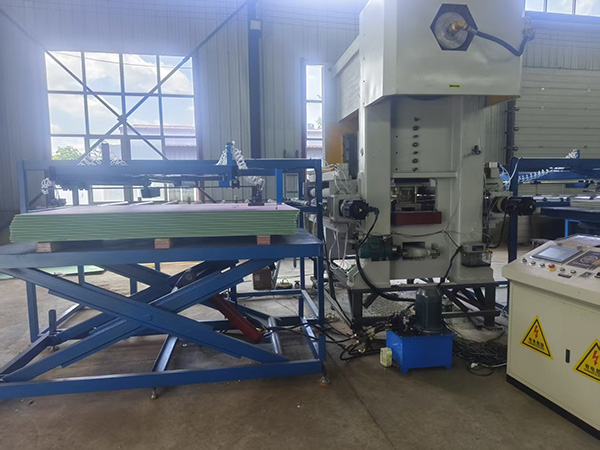
A gypsum board punching machine is a production system that punches a defined pattern of holes into plasterboard sheets at speed. It typically combines board feeding, precise positioning, perforating, dust extraction, and sometimes lamination in a single line. The machine is sized for standard board widths, commonly 1200 mm, and produces holes in a programmed grid that determines the panel's open area and therefore its acoustic absorption characteristics.
The core value is repeatability. Manual or workshop drilling produces inconsistent hole diameters, irregular spacing, and rough edges, which degrade both the visual appearance and the rated acoustic performance of the finished panel. A production punching machine delivers the same result board after board, which is what building-code and specification compliance actually require.
Key Features
Automated Punching Station
The perforating station uses a punch-and-die set or a multi-head gantry configuration. The punch drives through the board with enough force and speed to produce a clean hole without excessive edge chipping. Modern lines use servo-controlled feeding and positioning so that hole grids are placed accurately relative to the board edges and between rows.
CNC Pattern Control
CNC control stores hole patterns and drives board or head positioning. This allows flexible switching between hole diameters, pitches, and layouts without permanent tooling changes. Common patterns include round holes at various diameters, square holes, and linear slots, each producing a different open area and acoustic profile.
Dust Extraction System
Gypsum dust is abrasive and hazardous to breathe. The line includes extraction hoods and filtration at the tool and along the conveyor. Extraction capacity must match the board thickness and hole density; undersized extraction degrades operator safety, clogs tooling, and degrades hole quality.
In-Line Laminating
Many production lines apply an acoustic fleece or foil to the back of the board immediately after perforation. This is important because the open holes without backing reflect rather than absorb sound. The lamination step makes the panel a functional acoustic product rather than just a perforated board. Integrated lamination reduces handling and protects the holes from debris before the backing is applied.
Modular Tooling
Punching dies are modular, allowing quick exchange when switching between hole shapes or diameters. This supports mixed production without full machine changeovers, which matters for manufacturers supplying different market specifications.
Servo Feeding and Positioning
Accurate feeding and positioning are what make the difference between a board that passes specification inspection and one that does not. Servo-driven feeding with position feedback achieves tighter tolerances than mechanical indexing.
Industrial Applications
Perforated gypsum board produced on these machines is used in environments where sound control is important:
Ceiling panels in offices, corridors, and meeting rooms
Wall acoustic panels in schools, libraries, and lecture halls
Ceiling and wall panels in hospitals and healthcare facilities
Acoustic treatment in auditoriums, theatres, and concert halls
Wall and ceiling panels in restaurants, hotels, and public buildings
Industrial enclosures where acoustic lining reduces machinery noise
Recording studios, broadcast rooms, and media production facilities
In each case, the board must perform to a rated absorption coefficient, which depends on consistent hole geometry and open area.
How to Choose the Right Machine
Match board size. Confirm the maximum board width and length the machine accepts against your product range. Standard ceiling board is 1200 mm wide; some lines handle wider formats.
Define required patterns. List hole diameters, shapes (round, square, slot), and open area targets. These determine whether you need simple fixed dies or full CNC pattern flexibility.
Set throughput. Higher-volume operations benefit from automatic servo feeding and in-line lamination. Lower volume or custom work may accept simpler indexing systems.
Plan dust extraction. Verify the extraction capacity against your thickest board and densest hole pattern. This is not optional; it affects both safety compliance and hole quality.
Decide on lamination. If you sell finished acoustic panels rather than raw perforated board, an in-line laminator reduces a separate process step and protects panel quality.
Weigh pattern flexibility. Multi-head CNC systems allow pattern changes without tooling changes, which is useful for manufacturers supplying different market segments.
Check certifications. Acoustic performance claims should be supported by testing to recognized standards such as ISO 354 for sound absorption measurement.
Account for site requirements. Power supply, compressed air, floor space, and dust handling infrastructure all affect installation feasibility.
Maintenance and Operating Considerations
Punch and die cleaning. Gypsum builds up on tooling and must be cleared at regular intervals to keep hole quality and prevent oversized holes.
Dust filtration. Check and replace filters on schedule. Restricted airflow from clogged filters reduces extraction effectiveness and creates safety and quality issues.
Conveyor and positioning calibration. Verify alignment and recalibrate position sensors periodically to maintain hole-grid accuracy.
Laminator. If equipped, maintain roller pressure, adhesive supply, and web tension for even backing application.
Hydraulic system. For machines with hydraulic punch drives, check oil level, seals, and pressure per the manufacturer's schedule.
What to Provide When Requesting a Quote
Board dimensions and thickness range you will process
Required hole diameters, shapes, and open area targets
Target throughput and shift pattern
Whether in-line lamination is required
Power supply (voltage, phase, frequency) at the installation site
Required certifications and testing documentation for acoustic claims
Packing, shipping, or container requirements
Manufacturers such as Botou Mansen Machinery publish their manufacturing capabilities so buyers can verify production scale and process control before placing an order. You can review the company profile at the manufacturer's about page, and explore the range of related equipment at the main product site.
FAQ
What is the difference between a gypsum board punching machine and a gypsum board perforating machine?
Both terms describe the same type of machine. The terms are used interchangeably in the industry. What matters is the machine's specification for board size, hole pattern, throughput, and whether it includes in-line lamination.
What hole patterns can these machines produce?
Common patterns include round holes at various diameters, square holes, and linear slots. CNC multi-head systems support flexible grids and open areas that can be programmed to match specific acoustic specifications.
Can the machine laminate the acoustic backing in-line?
Many production lines include an integrated lamination station that applies fleece or foil immediately after perforation. If your product is a finished acoustic panel rather than raw board, specify in-line lamination when requesting a quote.
How is gypsum dust handled?
Extraction hoods and filtration capture dust at the tool and along the conveyor. Extraction capacity must match the board thickness and hole density. Neglecting dust extraction affects operator safety, tooling life, and hole quality.
What maintenance does the machine require?
Core tasks are clearing gypsum buildup from punches and dies, maintaining dust filtration, checking conveyor alignment, calibrating positioning, and for hydraulic machines, maintaining the fluid and seal system.
Conclusion
A gypsum board punching machine turns standard plasterboard into acoustic panels by placing consistent, accurately positioned holes at production speed. Key features to evaluate are punching force and tooling range, CNC pattern flexibility, dust extraction capacity, and whether lamination is integrated. For buyers, the practical value is repeatable open area that supports rated acoustic performance, lower labor cost per panel, and a finished product that passes specification inspection. Before requesting a quote, document the board dimensions, hole patterns, open area targets, throughput, and whether in-line lamination is needed.
References
ASTM C1396/C1396M, Standard Specification for Gypsum Board. ASTM International.
ISO 354:2003, Acoustics – Measurement of sound absorption in a reverberation room. International Organization for Standardization.
ISO 11654:1997, Acoustics – Sound absorbers for use in buildings – Rating of sound absorption. International Organization for Standardization.
Gypsum Association, GA-216: Application and Finishing of Gypsum Panel Products. Gypsum Association.
Kalpakjian, S., & Schmid, S. R. (2014). Manufacturing Engineering and Technology (7th ed.). Pearson.